Expanding seaweed bed restoration efforts: New experimental sites established in Jogashima and Manazuru
IJTT Co., Ltd. and Yokohama National University have established new experimental sites in the waters around Jogashima and Manazuru to further advance the demonstration of seaweed bed restoration in Sagami Bay.
Building on the insights gained from previous efforts, we will accelerate the development of a more practical restoration model and its verification for real-world implementation.
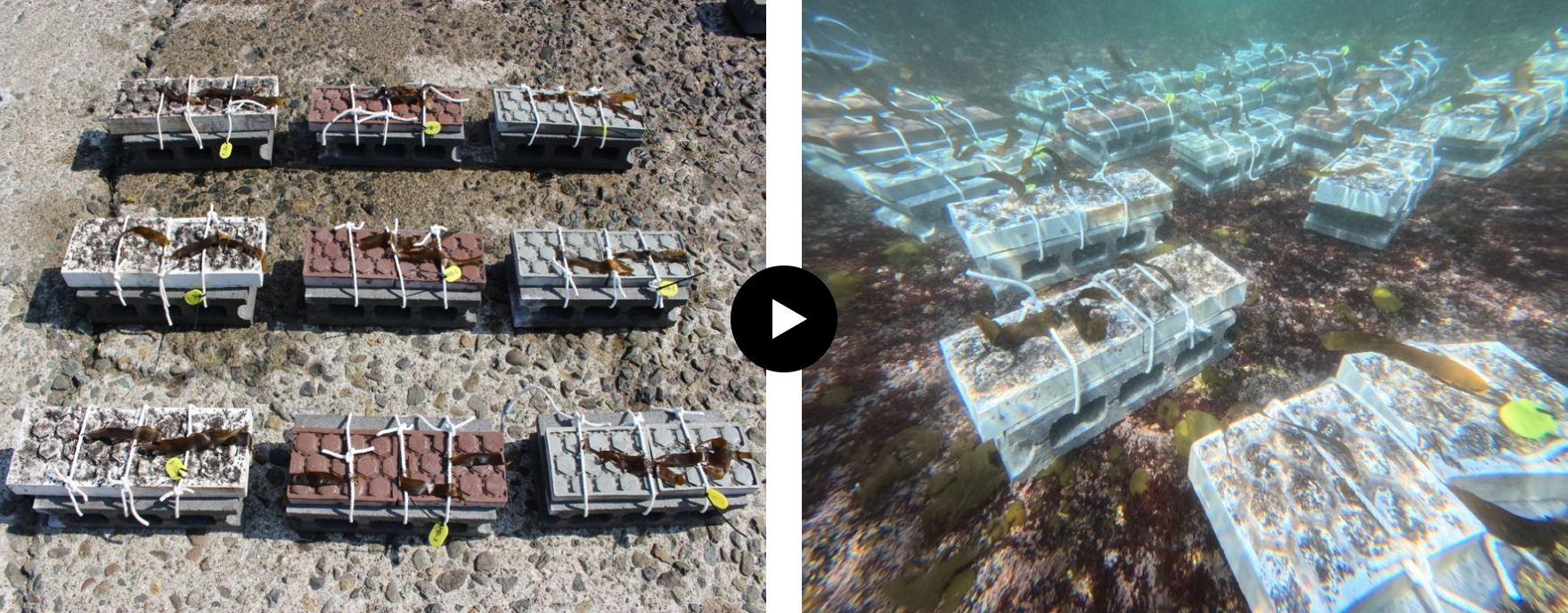
Moving the pilot program to the next phase
Since July 2025, IJTT and Yokohama National University have been conducting joint
demonstration research on seaweed bed restoration in Sagami Bay.
This additional
installation is part of an effort to conduct verification under conditions more closely
aligned with real-world conditions, based on the data and insights gained from the initial
demonstration.
In February 2026, new materials were added to existing experimental sites in the
Jogashima waters (February 12) and the Manazuru waters (February 16), and comparative
verification began.
Comparative Evaluation of “Materials” Key to Seaweed Bed Restoration
In this demonstration, we will examine how differences in substrate materials affect
seaweed bed restoration.
Specifically, we are comparing the following three types of materials:
-Foundry slag (a byproduct of casting)
-Foundry slag with added minerals
-Standard concrete slabs
The target seaweed is kelp, which grows in winter.
We will install these materials in
the same marine area and
continuously observe and analyze
seaweed colonization,
differences in growth,
and the leaching of inorganic nutrients,,
among other
factors.
Turning Manufacturing Byproducts into Ocean Restoration
In this demonstration project, IJTT is responsible for the design and development of the
substrate.
By utilizing foundry slag generated during the casting process,
we are
designing the optimal shape and weight
based on criteria such as stability in the
marine environment,
the promotion of seaweed colonization,
and nutrient supply
capacity.
These efforts go beyond mere experimentation;
they are part of a
“resource-circulating manufacturing” initiative that also envisions the future use of
these materials as port infrastructure.
A Regeneration Model Driven by Scientific Validation and Community Collaboration
Yokohama National University conducts marine environmental surveys and data analysis to
provide evidence-based assessments.
In collaboration with local governments, community organizations, and the fishing
industry, they are developing “implementation-oriented models” that go beyond mere
research.
By integrating these efforts with education and human resource development, they aim
to contribute to the creation of sustainable communities.
From Sagami Bay to real-world implementation
Going forward, we will verify the effectiveness of each material through ongoing
monitoring, with the aim of establishing the optimal method for seaweed bed restoration.
Furthermore,
we will expand these efforts to other regions,
generate blue carbon credits,
and make the value of the marine environment more visible.
Using our initiatives in Sagami Bay as a model case, we will strive to create new
value that harmonizes industry and nature.
For more details on this matter,
please refer to this press release.